
What are project management methodologies?
Project management methodologies are structured frameworks that define how a team plans, executes and delivers a project. Each one makes different assumptions about how work flows, whether that is a fixed sequence, parallel tracks or repeated cycles of improvement.
Some methodologies are traditional and sequential, moving through one phase before the next begins. Others are agile and iterative, delivering small pieces of value in short loops. Neither category is better on its own, and plenty of teams borrow from both.
The term covers this full range, from rigid plans mapped out months in advance to loose cycles that adapt week by week. Understanding where a method sits on that spectrum tells you far more than its name does.
Choosing the right approach depends on three factors: how predictable your scope is, how large and structured your team is and how often your requirements change. No methodology wins in every situation. This article compares seven methods and gives you a framework to match one to your work, not a ranking that names a single champion.
Think of a methodology like the layout of a kitchen. A busy restaurant needs stations that move food in one direction, while a home cook wants everything within reach for whatever they decide to make. Both layouts are correct for their context, and the same is true for how you run a project.
Seven project management methodologies compared
Below is a side-by-side look at the seven methods teams reach for most often. Each entry follows the same pattern so you can scan and compare quickly: what it is, how work flows, who it serves best and where it falls short. Read them together rather than in isolation, because the contrasts between them often reveal your own fit faster than any single description.
Waterfall: sequential, phase-by-phase delivery
Waterfall is a traditional approach that moves through defined phases in a set order. Each phase must finish before the next one starts, so the full plan is set at the beginning.
Work flows in one direction: requirements, then design, then build, then test, then deliver.
Waterfall is best for projects with a fixed scope and heavy regulatory demands, such as construction, manufacturing and government contracts.
It is not ideal when requirements are likely to shift after the plan is locked.
Agile: iterative delivery in short cycles
Agile is an iterative approach that breaks a project into short cycles rather than one long timeline. Teams plan, build and review in repeated loops, adjusting scope as they learn.
Work flows through small plan-build-review iterations that repeat until the product is done.
Agile project planning is best for teams whose requirements change often and who want to deliver value continuously.
It is not ideal for fixed-scope work that sits under strict compliance rules.
Scrum: a structured agile framework
Scrum is a specific way to run agile with defined roles and events. It assigns a product owner, a scrum master and a delivery team, and it organizes work into fixed-length sprints with regular ceremonies.
Work flows through sprint planning at the start of each sprint, daily coordination and a review and retrospective at the end.
The Scrum framework is best for product teams with dedicated members and a predictable cadence they can sustain.
It is not ideal for teams with variable workloads or no product owner to set priorities.
Kanban: continuous visual flow
Kanban is a visual approach built around a board that shows every piece of work as it moves. It uses columns for each stage and limits on work in progress rather than fixed iterations.
Work flows continuously across board columns, pulled forward as capacity opens up.
The Kanban method is best for ongoing streams of work, such as support queues, operations and maintenance.
It is not ideal for projects that depend on structured deadlines or formal sprint reviews.
Lean: eliminate waste, improve continuously
Lean is a mindset focused on removing anything that does not add value for the customer. It began with Toyota lean manufacturing and later spread into software, operations and services.
Work flows through a repeating cycle of measuring value, cutting waste and improving the process.
Lean is best for manufacturing, operations and process improvement, where small, steady gains compound over time into a leaner process.
It is not ideal for creative or exploratory work where the outcome is hard to define upfront.
PRINCE2: structured, governance-heavy
PRINCE2 is a formal method built around governance, documentation and clear accountability. It defines stages, roles and approval gates that a project must pass before it continues.
Work flows through controlled stages, each one signed off before the next begins.
PRINCE2 is widely used across the UK and EU public sector and suits large, multi-stakeholder projects with regulatory oversight.
It is not ideal for small teams or fast-moving work that cannot absorb the overhead.
Hybrid: combine Waterfall and Agile
Hybrid blends traditional planning with agile execution. Teams scope and plan the project up front like Waterfall, then deliver the work in agile cycles.
Work flows through fixed planning at the start, followed by iterative delivery through to the finish.
Hybrid is best for teams moving toward agile or those that need fixed milestones with flexible delivery in between.
Decision framework: which methodology fits your team?
Use the table below to align the seven methods with the factors that matter most.
Factor
Waterfall
Agile
Scrum
Kanban
Lean
PRINCE2
Hybrid
Scope predictability
High
Low
Medium
Low
Medium
High
Mixed
Team size
Any
Small-medium
5-9
Any
Any
Large
Any
Iteration length
None
1-4 weeks
2 weeks
Continuous
Continuous
Stage-based
Mixed
Change tolerance
Low
High
Medium
High
Medium
Low
Medium
Best industry fit
Construction, govt
Software, product
Product, content
Ops, support
Manufacturing
Public sector, enterprise
Most teams
Once you have scanned the table, three questions narrow the field fast. Many teams weigh Scrum vs. Kanban at this stage, so the second and third questions help distinguish between them.
Is your scope fixed or evolving? Fixed points you toward Waterfall or PRINCE2. Evolving points you toward Agile, Scrum, or Kanban.
Does your team need regular delivery deadlines? Yes, points you toward Scrum. No points toward Kanban.
Is your primary goal waste reduction or value delivery? Waste reduction points you toward Lean. Value delivery points you toward Agile.
Treat the answers as a starting point, not a verdict.
Start by mapping your team's size and distribution. A co-located team of five can run lightweight Kanban with minimal ceremony, while a distributed group of thirty often needs the checkpoints and regular sync points that a scaled Agile framework provides. Next, assess how often requirements shift. If scope changes every sprint, iterative methods like Scrum offer built-in flexibility. If deliverables are locked from day one, a linear approach like Waterfall keeps everyone aligned. Then factor in compliance. Highly regulated industries often require the traceability and documentation that traditional methodologies provide. Finally, consider client involvement. Frequent client feedback loops point toward Agile, whereas a single sign-off at each gate suits stage-based models better.
Choosing the right methodology starts with an honest look at four factors. First, consider your team's size and distribution: a co-located team of five can thrive with lightweight Kanban, while a distributed group of thirty may need the ceremony and checkpoints of a scaled Agile framework. Second, assess how often your requirements change. If the scope shifts every sprint, iterative methods like Scrum give you built-in flexibility. If the deliverables are locked from day one, a linear approach like Waterfall keeps everyone aligned. Third, factor in regulatory or compliance needs. Highly regulated industries often require the traceability and documentation that traditional methodologies provide. Finally, think about how involved your clients need to be. Frequent client feedback loops point toward Agile, whereas a single sign-off at each gate suits stage-based models better.
A finance team with steady compliance work might land on Kanban, while a product team shipping features every two weeks leans toward Scrum.
Picture a mid-sized manufacturer planning a new production line. The scope is largely fixed and the work sits under safety and quality rules, so the first question points toward Waterfall or PRINCE2. The engineering leaders want firm sign-offs at each stage, which favors PRINCE2, while the maintenance crew that keeps existing lines running needs a steady flow with no fixed sprints, so Kanban fits them better. One organization, two teams and two methods: that split is normal rather than a sign that anyone chose wrong.
Run the same three questions for each team rather than picking one method for the whole company. The point is to match the work in front of a group to the way that group delivers day to day. When the method mirrors how the team already thinks about its work, adoption tends to stick.
How to implement your chosen methodology in MeisterTask
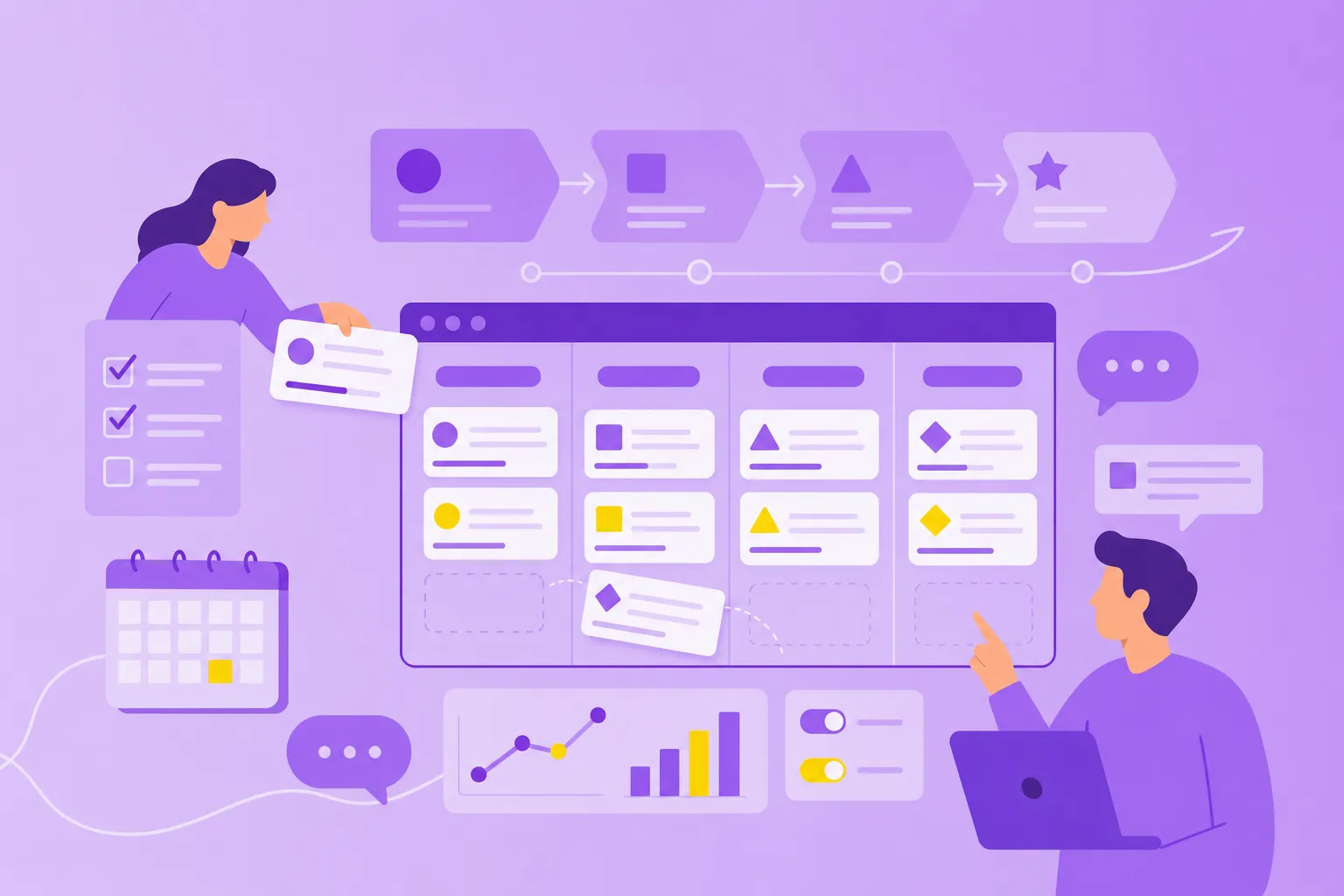
MeisterTask gives you one flexible Kanban board structure that adapts to whichever method you choose, so you do not have to switch tools when your process changes. Here is how four of these methodologies map onto it, using the same drag-and-drop board your team already knows.
For Waterfall, set up your board sections as project phases, from requirements through to delivery. Tasks move left to right through each phase, and no card moves backward once a phase is signed off.
For Scrum, create a backlog project alongside a dedicated sprint board. Pull work from the backlog into each sprint, and add recurring tasks for sprint planning and retrospectives so the cadence stays consistent.
For Kanban, use a standard board with limits on work in progress in each column. Work flows continuously as capacity opens, with no fixed iterations to plan around, so the board reflects the real state of work at any moment.
For Lean, keep an improvement backlog for ideas that reduce waste. Add recurring audit tasks to review the process, and track Kaizen action items as individual cards you can assign and close.
Because all four setups share the same board structure, a team can shift from one method to another without rebuilding its workspace or retraining on a new tool. A group piloting Scrum can drop the sprint board and switch to continuous Kanban flow when their workload turns unpredictable, and the tasks they already created come along with them.
One selection criterion often gets overlooked: where your data lives. MeisterTask is GDPR-compliant and hosted in Germany, which matters for public sector, manufacturing and finance teams that answer to EU data privacy rules. Many competitors host elsewhere and cannot make the same commitment, so this deserves a place on your checklist next to features and price. For a public sector IT team or a manufacturing owner, that answer can decide the shortlist before a single feature is compared.
Turn your methodology into momentum
The best methodology is the one that fits your team's reality, not the one with the most followers online. Your scope, your size and your appetite for change all point toward a natural fit. Revisit that choice as your team grows and your work shifts, because the right answer today may look different in a year. A method that felt like overhead for a five-person team can become the structure a thirty-person department depends on.
Whichever method you land on, the goal stays the same: keep work organized, keep progress transparent and keep your data secure. MeisterTask brings tasks, documentation and collaboration into one place so your team can see the plan, track the work and trust where everything lives. Pick the method that fits, set it up once, and give your team a clear path forward.