
What is lean manufacturing?
Lean manufacturing (also known as lean production) is a production management system developed by Toyota in the 1950s. It is focused on eliminating waste and maximizing value at every step of the production process. Its core principle: deliver more value to the customer with less resource input.
The term was coined by researchers at MIT in their 1990 study, The Machine That Changed the World, which documented Toyota's production system and introduced lean manufacturing as a global standard.
In lean manufacturing, waste (called Muda in Japanese) is defined as any activity that consumes resources without creating customer value. Lean identifies seven types of waste: overproduction, waiting, unnecessary transport, over-processing, excess inventory, unnecessary movement, and defects.
Lean manufacturing is not the same as lean management, though the two are closely related. Lean manufacturing focuses specifically on production processes. Lean management is the broader application of lean principles across the entire organization — including administration, logistics, and service.
The core lean manufacturing methods
Lean manufacturing is not a single tool — it is a system of interconnected methods. These are the five that matter most for production teams in practice.
Kaizen and CIP
Kaizen is the philosophical foundation of lean manufacturing. It describes a mindset of continuous, incremental improvement involving every employee — from the production line to leadership. In the Western business context, Kaizen became the Continuous Improvement Process (CIP), also known as KVP in German-speaking markets.
CIP applies the Kaizen mindset through a structured business process: problems are identified, solutions developed and tested in small steps, and successful improvements documented as the new standard. Unlike one-off optimization projects, CIP has no end date — it is a permanent operating cycle.
PDCA cycle
The PDCA cycle (Plan–Do–Check–Act) is the engine that drives CIP. It structures continuous improvement into four repeating steps:
Plan: Analyze the problem, understand root causes, define a measurable goal
Do: Test the proposed solution on a small scale
Check: Measure results against the original goal
Act: Establish successful changes as the new standard and begin the next cycle
5S
5S is a workplace organization method that creates the physical and procedural foundation for lean manufacturing. The five steps — Sort, Set in order, Shine, Standardize, Sustain — eliminate physical waste and create a consistent, safe working environment where problems are immediately visible.
5S is typically the first lean method introduced in a production environment because its results are immediate and visible, which builds team confidence in the lean approach.
Value stream mapping
Value stream mapping visualizes every step in a production process — from raw material to finished product — and distinguishes value-adding steps from waste. It gives production teams a shared picture of how work actually flows, where delays and inefficiencies accumulate, and where improvement efforts will have the highest impact.
Kanban
Kanban controls the flow of materials and information in production by making work visible. Tasks move as cards through defined workflow stages, limiting work in progress and ensuring that production responds to actual demand rather than forecast schedules. In digital lean environments, Kanban boards extend this principle to task management — every improvement action has an owner, a status, and a deadline.
Why lean manufacturing initiatives fail in practice
Most lean manufacturing programs start well. A 5S workshop introduces order to the shopfloor. A value stream analysis identifies ten improvement opportunities. A Kaizen event generates concrete action items. In the first weeks, momentum is high.
Then it fades. Action items from the Kaizen event sit unassigned. The 5S audit schedule slips when the lean manager is on leave. Improvement suggestions from the shopfloor get lost in email threads. The next workshop finds the team nearly back where it started.
The failure is rarely the method. It is the missing coordination structure between workshops. Lean manufacturing tells your team what to improve. It does not automatically ensure the improvements actually happen.
This is the gap that digital tools fill — not as a replacement for lean methodology, but as the coordination layer that keeps lean initiatives moving between events.
Lean manufacturing in practice: the six phases of continuous improvement
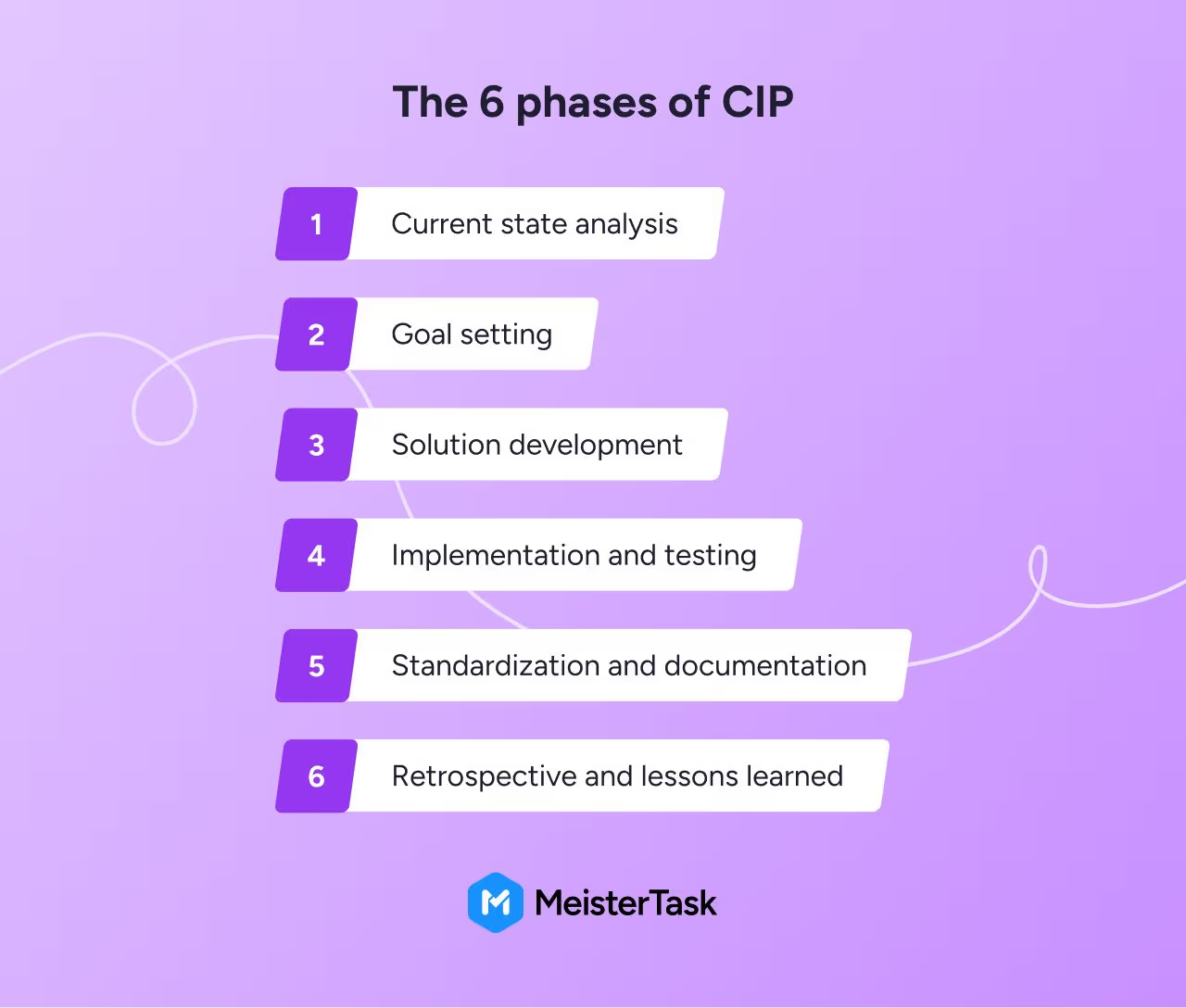
Lean manufacturing's continuous improvement process follows six phases that take a production problem from identification to embedded standard.
1: Current state analysis
Gain a precise picture of how the process currently runs. Collect performance data, conduct Gemba Walks (on-site observations at the point of work), and run short shopfloor meetings. The goal is to see the process as it actually operates — not as it is documented — and identify root causes of inefficiency. Visual documentation makes weak points visible to the whole team.
2: Goal setting
Define clear improvement targets based on the current state analysis. Goals should follow the SMART criteria: Specific, Measurable, Achievable, Relevant, and Time-bound. Example: reduce the defect rate by 10% over the next six months. Structured targets allow objective measurement of progress.
3: Solution development
Analyze root causes systematically and develop practical solutions using two proven methods:
5 Whys: Ask "why?" repeatedly until you reach the true underlying cause rather than the visible symptom
Ishikawa diagram: Map all potential contributing factors — materials, machines, methods, people — to identify patterns and pinpoint where action will have the highest impact
Once causes are understood, the team generates improvement proposals and evaluates them by impact and feasibility.
4: Implementation and testing
Test selected solutions in pilot areas first. Small-scale experiments limit risk while generating fast feedback. Document results clearly and measure outcomes against the defined goals. Keep communication open throughout — shopfloor teams closest to the process have the most relevant insight.
5: Standardization and documentation
When a solution proves effective, embed it as the new standard. Update standard operating procedures, training materials, and quality documentation. Digital workflows are a significant advantage here: updates are stored centrally, properly versioned, and immediately accessible to the entire team.
6: Retrospective and lessons learned
After implementation, take structured time to reflect. What worked? What obstacles appeared? What would be done differently? Lessons learned workshops capture this knowledge and feed it directly into the next improvement cycle — ensuring the organization gets smarter with each iteration.
How MeisterTask supports lean manufacturing
Many lean initiatives stall because the coordination structure between workshops is missing. Action items get assigned verbally or noted on whiteboards — and then forgotten. MeisterTask provides the digital coordination layer that keeps lean manufacturing improvements on track.
Kaizen action items as trackable tasks: after a Kaizen event, every action item becomes a MeisterTask card with a named owner, a due date, and a status visible to the whole team. Nothing gets lost in a whiteboard photo or a spreadsheet that nobody updates.
5S audits as recurring tasks: schedule 5S audits as recurring tasks in MeisterTask — automatically assigned to the responsible person every four weeks, with a checklist attached. The audit happens on schedule regardless of who is on leave.
Improvement suggestions as a shared backlog: create a backlog section in MeisterTask where shopfloor teams can log improvement suggestions directly. Ideas are visible, prioritized, and assigned — not lost in email threads or suggestion boxes that nobody reviews.
Lean documentation in MeisterNote: Use MeisterNote to document standard operating procedures, PDCA results, and lessons learned in a searchable, shared knowledge base that carries forward into every new project. Each document links directly to the relevant MeisterTask action items — connecting knowledge to execution in one workspace.
MeisterTask is GDPR-compliant and hosted in Germany, making it a trusted choice for production teams in regulated industries and public sector manufacturing contexts.
Real-world examples from manufacturing teams
Ritter Sport — shopfloor communication. At its plant in Waldenbuch, Ritter Sport replaced paper lists and fragmented communication with MeisterTask's centralized task management. All teams now see who owns which task and can track open items during daily shopfloor meetings. The result: faster decisions, more efficient meetings, and measurably fewer communication breakdowns.
FiSCHER — production and logistics workflows FiSCHER manages invoice approvals, returns, and fleet administration in MeisterTask. Automated workflows and integrated time tracking replaced long email threads, freeing up team members to focus on value-adding work.
Felix Schoeller Group — reducing administrative overhead. By combining mind mapping with task tracking, the Felix Schoeller Group reduced admin time by 50%. Teams now link agendas, tasks, and decisions directly — making all project information accessible and easy to follow up on.
What makes a lean manufacturing culture sustainable
Tools are one part of the equation. A sustainable lean manufacturing culture depends equally on people, mindset, and leadership behavior.
Inclusive participation. Every employee — from production to logistics, quality to maintenance — should have a voice in improvement efforts. Make it clear that every idea matters and create a space where teams contribute openly without fear of judgment.
Leaders who model lean behavior. Managers who visibly champion lean initiatives — removing obstacles, providing feedback, recognizing improvements — create teams that engage. When leadership treats lean as a formality, teams follow suit.
Start small, celebrate early. Quick wins show that the process works and build team ownership. Don't wait for a major transformation before communicating progress.
Make retrospectives routine. Reflection is not optional in lean manufacturing — it is the mechanism that compounds improvement over time. Regular retrospectives ensure the organization learns from every cycle.
Track meaningful metrics. Use KPIs that connect lean activity to business outcomes: defect rate reduction, throughput time improvement, and number of implemented improvements per quarter. Clear metrics make lean manufacturing tangible and justify continued investment.
Lean manufacturing and ESG
Lean manufacturing and ESG goals are more closely connected than is often recognized. Waste elimination directly reduces energy consumption and material use. Standardized processes make compliance documentation easier and more reliable. Teams that operate with lower waste and higher efficiency are more resilient to supply chain disruption and regulatory pressure.
For manufacturers navigating ESG reporting requirements, lean manufacturing provides both the operational foundation and the documented evidence that ESG programs need to be credible.
Lean manufacturing: better every day
In manufacturing, continuous improvement is not a best practice — it is a competitive necessity. Lean manufacturing gives your team the methods to identify and eliminate waste systematically. CIP, Kaizen, and PDCA provide the cycle. MeisterTask provides the coordination structure that keeps improvements on track between workshops.
The result is a production operation that gets measurably better with every cycle — and a team that owns the improvement process rather than waiting for the next consultant to run a workshop.
FAQs | Continuous improvement in manufacturing
Kaizen is a Japanese philosophy of continuous improvement that encourages all employees to contribute small, ongoing changes. CIP (Continuous Improvement Process) applies this mindset in a structured business context using tools like PDCA cycles, 5 Whys, or the Ishikawa diagram.
In manufacturing, every inefficiency — from downtime to defects — leads to real, measurable costs. Lean principles show that eliminating Muda (waste), Mura (inconsistency), and Muri (overload) can significantly boost productivity. CIP provides a structured way to reduce these issues step by step and stabilize operations.
Digital platforms offer Kanban boards, centralized documentation, and automation — helping teams work more transparently, take ownership, and move faster. They eliminate paper-based processes and make it easier to connect CIP efforts to existing quality or ERP systems. Real-life examples show that companies have cut admin time and made meetings more effective as a result.
PDCA stands for Plan – Do – Check – Act. It’s an iterative framework for implementing change: define the problem, test a solution, evaluate the outcome, and standardize improvements. It’s the foundation of CIP and ensures that changes are both effective and sustainable.
Most quality frameworks, like ISO 9001, require continuous improvement as a core principle. CIP supports these standards with clear structure, employee involvement, and thorough documentation. Digital workflows make it easier to manage process updates and prepare for audits efficiently.